You Won’t Believe This Secret Festival Life in Hanoi
Hanoi isn’t just about pho and ancient temples—deep in its alleyways pulses a hidden festival culture most travelers never see. I stumbled upon it by chance, and honestly? Mind-blowing. From neighborhood spirit offerings to drum-lit processions at midnight, these aren’t performances for tourists. They’re real, raw, and deeply rooted in local life. If you’re craving something beyond the guidebooks, this is it. These intimate celebrations unfold in quiet courtyards, along tree-lined lanes, and beneath centuries-old banyan trees, where generations gather not for show, but for continuity. To witness them is to glimpse the heartbeat of Hanoi—one that beats steadily beneath the city’s bustling surface.
The Hidden Pulse of Hanoi
Hanoi presents itself to the world with pride: the French colonial architecture of the Opera House, the bustling energy of Hoan Kiem Lake, the fragrant chaos of Dong Xuan Market. Yet beyond these well-trodden sights lies another city entirely—one governed not by clocks or tourist itineraries, but by lunar cycles, ancestral memory, and quiet devotion. This is the Hanoi of neighborhood shrines tucked between apartment buildings, of sudden clusters of incense smoke rising from sidewalk altars, and of whispered prayers at dawn. These moments are not curated; they are lived. The rhythm of this hidden Hanoi pulses strongest during its lesser-known festivals, which unfold without fanfare but with profound intention.
In the early morning light of a nondescript residential ward in Ba Dinh District, life begins as it does across much of the city—quietly, deliberately. But on certain days, something shifts. Overnight, small wooden altars appear at the foot of apartment stairwells or beneath awnings. Red cloth drapes over simple tables, laden with offerings: bowls of fruit, cups of tea, plump sticky rice cakes, and burning joss sticks sending curls of fragrant smoke into the air. These are not random acts of faith but precise preparations for a local festival, often tied to the death anniversary of a village elder, a temple’s founding, or a seasonal rite marking the balance between the human and spirit worlds.
What makes these displays so powerful is their ordinariness. There are no barricades, no admission fees, no crowds of onlookers with cameras. A grandmother might kneel briefly before the altar, bow three times, then return to sweeping her doorstep. A delivery motorbike weaves carefully around the offering table, the rider nodding respectfully as he passes. These festivals are not events; they are part of the fabric. They remind visitors that in Hanoi, spirituality is not confined to pagodas or holidays—it lives in the cracks of daily life, sustained by quiet acts of remembrance and gratitude.
Why These Festivals Stay Secret
The invisibility of these festivals to most outsiders is not accidental. It is a product of intention, scale, and cultural context. Unlike the grand Tet celebrations or the Mid-Autumn Festival parades that draw international attention, these neighborhood observances are small, localized, and often conducted in private or semi-private spaces. They are not designed for spectacle. Many occur on dates determined by the lunar calendar, which are not widely publicized in English or listed on tourist apps. Without local knowledge or connections, even the most curious traveler would likely pass by without realizing a sacred moment was unfolding just steps away.
Language is another barrier. Announcements about upcoming rites are typically posted in Vietnamese on community bulletin boards outside pagodas or in local government offices—places rarely visited by foreign guests. Invitations are verbal, passed from neighbor to neighbor, family to family. There is no digital marketing, no social media buzz. The festivals rely on oral tradition and communal trust, both of which exclude those who do not speak the language or live in the area.
Equally important is the deeply personal nature of these events. Many are religious or ancestral in character, rooted in Vietnamese folk beliefs that blend Buddhism, Confucianism, and animism. They are not performances but acts of duty and respect—moments when families honor those who came before them or express gratitude to protective spirits. For outsiders to intrude, especially with cameras or loud questions, would be seen as disrespectful, even disruptive. Even some younger residents in newer urban districts are only vaguely aware of the traditions practiced in older communities, highlighting a generational gap that further isolates these customs from broader awareness.
The Spirit of Neighborhood Celebrations
At the heart of Hanoi’s hidden festival life is the neighborhood—the pho, a cluster of homes and families bound by geography and shared history. These communities come alive during events like Tết Đoan Ngọ, a mid-year festival held on the fifth day of the fifth lunar month, traditionally meant to ward off illness and evil spirits. While largely unrecognized by tourists, it remains a meaningful occasion in many residential areas. Families prepare special foods, including cơm rượu—fermented glutinous rice—and bitter herbs believed to cleanse the body. Doorways are adorned with sprigs of mugwort, and children are gently scolded if they step over incense lines drawn in chalk outside homes.
Another common celebration is the death anniversary rite, known as giỗ. On these days, families gather at home or at a local temple to prepare elaborate meals for the deceased. The offerings are not symbolic—they are real dishes, often the favorite foods of the departed, served on proper plates with chopsticks upright in rice, a sign that the spirit is being fed. After an hour of prayer and remembrance, the family eats the same meal, creating a powerful sense of continuity between the living and the dead. These rituals are not about mourning but about maintaining connection, reinforcing the belief that ancestors remain part of daily life.
Temple anniversaries, or hội, also play a vital role. Each ward has its own protective deity or historical figure enshrined in a small neighborhood pagoda. When the temple’s founding date comes around, the community organizes a modest festival. Elders take the lead, coordinating food preparation, incense supplies, and volunteer shifts for cleanup. Children help decorate with red banners and paper lotus flowers. The event may include a short procession, chanting by local monks, and a shared meal. Participation is expected, not optional—a way of fulfilling one’s role in the social and spiritual ecosystem of the neighborhood.
A Midnight Drum Procession I’ll Never Forget
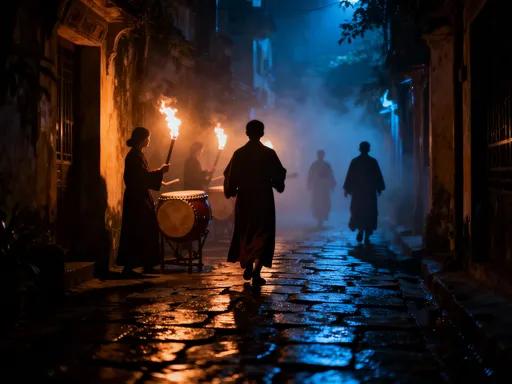
One humid June night, while staying in a guesthouse near West Lake, I awoke to the distant sound of drums. At first, I thought it was a dream or a late-night party. But the rhythm was too steady, too deliberate—deep, resonant beats rolling across the water like waves. Curious, I stepped onto the balcony. Across the lake, torches flickered along the tree-lined path. A procession was moving slowly through the darkness, a line of men and women in simple white tunics carrying drums, gongs, and flaming lanterns.
I later learned this was part of a spirit festival honoring a local guardian deity believed to protect the lakeside community from floods and misfortune. The procession followed an ancient route, circling the lake counterclockwise to symbolize the warding off of negative energy. The drums were not played for entertainment but as a form of communication—with the spirits, with the earth, with the ancestors. Each beat was a prayer, a call, a declaration of presence.
Watching from a distance, I felt a strange duality: a deep sense of awe, but also discomfort. I was an outsider, witnessing something sacred without invitation. Yet, when I quietly walked down to the lakeside path, no one turned me away. An elderly woman offered a small lantern with a nod. I held it without speaking, falling into step behind the drummers. The air was thick with the scent of lotus and burning camphor. Frogs croaked in the reeds. The water shimmered under the moonlight. In that moment, I wasn’t a tourist. I was simply a witness to something timeless—a community reaffirming its identity through rhythm, fire, and faith.
How to Find These Hidden Festivals (Without Intruding)
Discovering these festivals requires patience, humility, and a willingness to slow down. The first step is building local connections. Guesthouse owners, neighborhood coffee shop vendors, and temple caretakers often know about upcoming events. A simple question—asked politely and with genuine interest—can open doors. Phrases like “Is there a festival coming up?” or “Are the pagodas celebrating anything this month?” can lead to quiet nods and whispered information.
Another effective method is to visit neighborhood pagodas regularly, especially in older districts like Hoan Kiem, Dong Da, or Tay Ho. Notice boards outside these temples often list upcoming ceremonies in Vietnamese. Even if you can’t read the script, taking a photo and asking a bilingual local for translation can yield surprising results. Timing matters, too. Lunar new year periods, full moons, and the seventh lunar month—known as the Hungry Ghost Month—are peak times for rituals. During these phases, the frequency of neighborhood offerings increases noticeably.
When you do encounter a festival, the most important thing is to observe respectfully. Dress modestly—avoid shorts, tank tops, or loud clothing. Stand at a slight distance unless invited closer. Never touch ritual objects, step over incense, or block the path of participants. Photography should be discreet, if allowed at all. A quick nod or a quiet “Xin lỗi” (excuse me) goes a long way. Remember, your presence is a privilege, not a right. The goal is not to capture the perfect photo but to absorb the moment with humility and gratitude.
Festival Food: The Unsung Star
If music and ritual are the soul of Hanoi’s hidden festivals, food is the body. Every celebration, no matter how small, centers around specially prepared dishes meant for both offering and sharing. These are not street food snacks but carefully crafted items made with intention. Chè, a sweet dessert soup made from beans, lotus seeds, or tapioca, is a common offering, symbolizing sweetness and harmony. Bánh dày, dense white rice cakes pounded to a smooth texture, are presented to ancestors as a sign of purity and respect. During Tết Hanh, families prepare nine-layer rice cakes to represent the connection between earth and sky.
What makes festival food so meaningful is its role in building community. Cooking is often a group effort—mothers, daughters, aunts, and neighbors gathering in a home kitchen or temple courtyard to pound rice, stir pots, and wrap sticky parcels in banana leaves. The process itself is meditative, a form of collective devotion. Once the offerings have been presented and blessed, the food is shared among participants. This act transforms ritual into relationship. I experienced this firsthand when, after a temple anniversary rite, an elderly woman handed me a small bowl of warm chè đậu trắng—white bean sweet soup. “For good luck,” she said with a smile. That simple gesture, that warm sweetness on my tongue, felt more authentic than any five-star meal.
These foods are rarely found in restaurants or night markets. They are made only for festivals, using family recipes passed down through generations. To taste them is to be welcomed—not as a customer, but as a guest. It is a reminder that in Vietnamese culture, sharing food is one of the highest forms of trust and belonging.
Preserving the Invisible: Challenges and Hope
Despite their depth and beauty, Hanoi’s hidden festivals face growing threats. Urbanization is reshaping the city at a rapid pace. Historic neighborhoods are being demolished or redeveloped, breaking up long-standing communities. Younger generations, drawn to modern lifestyles and global influences, often view these traditions as outdated or irrelevant. In some areas, the knowledge of how to conduct proper rites is fading, passed down only in fragments. Without active effort, these festivals risk becoming memories rather than living practices.
Tourism, while a source of economic benefit, can also distort tradition. When rituals are commercialized or staged for visitors, they lose their authenticity. Some neighborhoods have begun to resist this trend by setting clear boundaries—refusing to perform private ceremonies for outsiders or limiting access during sacred times. At the same time, grassroots efforts are emerging to document and sustain these practices. Local historians, cultural NGOs, and community elders are working together to record oral histories, map traditional festival calendars, and teach younger residents about their heritage.
There is hope in the quiet resilience of these communities. In one ward in Long Bien District, a youth group has started organizing intergenerational workshops where elders teach children how to make ceremonial foods and play traditional instruments. In Tay Ho, a community-led festival registry now shares information in both Vietnamese and basic English, allowing respectful travelers to participate without intrusion. These efforts show that preservation does not require exposure—it requires intention, respect, and continuity.
Travelers, too, have a role to play. By choosing to value authenticity over convenience, by listening more than speaking, and by honoring the unspoken rules of participation, visitors can become allies in cultural preservation. A quiet presence, a modest offering, a shared meal—these small acts can affirm the dignity of traditions that might otherwise fade.
These secret festivals aren’t just cultural relics—they’re living threads connecting past and present. By stepping back, listening, and honoring the unspoken rules, travelers can witness something truly rare: Hanoi’s soul in motion. The real journey isn’t about seeing more—it’s about understanding deeper.