Lima Just Blew My Mind — This Is Not Your Average Check-In
You know that feeling when you expect a quick stopover but end up discovering a whole new world? That was me in Lima. I came for the views, stayed for the food — and honestly, never saw it coming. From street-side anticuchos sizzling at dusk to high-end ceviche that tastes like the ocean kissed your tongue, Lima’s dining scene is next-level. This isn’t just a meal; it’s a full sensory check-in to Peru’s soul. The city hums with quiet confidence, its coastal breeze carrying the scent of grilled meat, citrus, and warm corn. What began as a two-night layover turned into a week-long culinary pilgrimage, reshaping how I think about travel, connection, and authenticity. Lima doesn’t shout — it whispers, invites, and then, suddenly, overwhelms with flavor.
First Impressions: Landing in Lima with Low Expectations
Touching down at Jorge Chávez International Airport, the mood was predictable: transit, not transformation. Most travelers see Lima as a necessary pause — a place to collect bags, catch a breath, and board the next flight to Cusco or the Sacred Valley. The skyline, stretching along the Pacific coast, looked dusty and unassuming under a pale morning sun. Traffic inched forward, the city waking slowly beneath a soft coastal mist known locally as garúa. It wasn’t the dramatic Andean peaks or jungle canopies that drew me in — it was a simple question from my taxi driver: "¿No ha comido todavía? Le recomiendo un buen anticucho." (“Haven’t you eaten yet? I recommend a good anticucho.”)
That moment marked the shift. What could have been a forgettable transfer became the start of a conversation about food, pride, and place. He spoke of family recipes passed down for generations, of weekend gatherings centered around a shared pot of stew, of the way a perfectly grilled skewer could tell you everything about a city’s spirit. His passion was infectious, and by the time we reached my hotel in Miraflores, I wasn’t just hungry — I was curious. Lima, I realized, wasn’t a gateway. It was a destination with stories simmering beneath the surface, waiting to be tasted.
The Heartbeat of Lima: Why Food Defines the City
In 2012, UNESCO recognized Lima as a Creative City of Gastronomy, a title that reflects more than just culinary excellence — it speaks to identity. For Peruvians, food is memory, history, and community rolled into one. Lima’s cuisine is a living archive of migration and adaptation, where indigenous ingredients meet colonial techniques, African rhythms, and Asian precision. This fusion isn’t forced; it’s natural, generations in the making. A single plate of lomo saltado — stir-fried beef with tomatoes, onions, and fries, served with rice — tells the story of Chinese immigrants adapting to local tastes in the 19th century. A bowl of ocopa, a creamy sauce made with peanuts and huacatay (Andean mint), carries the legacy of pre-Columbian agriculture.
At the heart of this rich tapestry is comida criolla, or creole cuisine, the soul of Lima’s home cooking. These are the dishes served at Sunday family lunches: slow-cooked stews, hearty soups, and rice-based casseroles that vary from household to household. Meals are rarely eaten alone. They are events, shared with laughter, stories, and multiple refills. Dining in Lima is not transactional — it’s relational. Whether in a bustling market or a polished restaurant, the act of eating is an invitation to belong, even if just for one meal. This cultural emphasis on connection through food makes every bite feel meaningful, not just delicious.
Street Food Awakening: Eating Like a Local from Day One
If Lima’s soul lives in its food, then its pulse beats strongest in the streets. My first full day began in Barrios Altos, one of the city’s oldest neighborhoods, where colonial buildings lean slightly with age and the scent of wood smoke lingers in the air. I followed a local recommendation to a picantería — a traditional eatery often run out of a home kitchen, open only during lunch hours. The space was crowded, noisy, and utterly alive. Long wooden tables filled with regulars, steam rising from clay pots, and the constant sizzle of grills behind the counter.
I started with anticuchos, skewers of marinated beef heart grilled over hot coals. The idea might sound bold to some, but the result is tender, smoky, and deeply savory, seasoned with cumin, vinegar, and ají panca. Next came tamales — steamed corn dough wrapped in banana leaves, filled with pork and olives — and humitas, a sweeter version made with fresh corn and cheese. A glass of chicha morada, a non-alcoholic purple corn drink flavored with cinnamon and cloves, balanced the richness perfectly. What struck me wasn’t just the flavor, but the confidence with which people ate — no hesitation, no拍照, just enjoyment.
For travelers, street food can feel intimidating. But in Lima, safety comes from observation. Look for stalls with high turnover, clean surfaces, and locals lining up. Vendors who keep ingredients covered, use gloves or tongs, and serve food hot are usually reliable. Many of Lima’s best dishes are born on the street, perfected over decades by cooks who understand that consistency, freshness, and love are the true ingredients of greatness. To skip street food is to miss the essence of the city.
Ceviche Chronicles: Chasing the Perfect Bite by the Coast
No culinary journey in Lima is complete without ceviche, the country’s national dish and a masterclass in simplicity and precision. I made my pilgrimage to the district of Chorrillos, a working-class fishing neighborhood where the ocean is never more than a few blocks away. At a seaside spot recommended by a local chef, I watched fishermen unload the morning’s catch — silvery sea bass, fat octopus, and plump scallops — just before they were whisked into the kitchen.
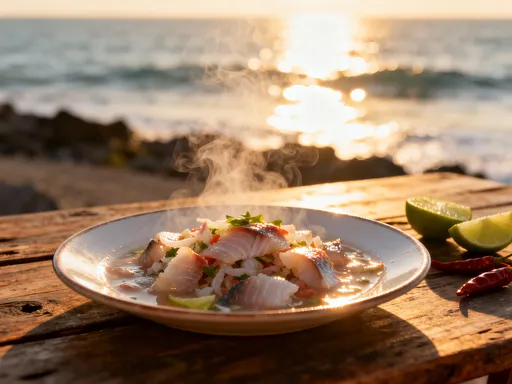
The ceviche arrived moments later: translucent cubes of raw fish bathed in lime juice, mixed with thin slices of red onion, ají limo for heat, and a splash of leche de tigre — the “tiger’s milk” marinade that gives the dish its legendary kick. The fish had barely begun to “cook” in the citrus, preserving its delicate texture. One bite, and the flavors exploded — bright, briny, spicy, clean. This was not the over-marinated, rubbery version sometimes found elsewhere. Timing is everything: ceviche is best eaten at noon, when the fish is freshest and the lime’s acidity is balanced, not overwhelming.
Some modern interpretations add mango, avocado, or sweet potato in creative ways, but the traditional version remains unmatched in its purity. What makes it special isn’t just the ingredients — it’s the ritual. Ceviche is served with cancha (toasted corn) for crunch and a side of sweet potato to mellow the acidity. It’s a dish meant to be shared, discussed, savored slowly. In that moment, with the sound of waves in the background and salt on my lips, I understood why Peruvians speak of ceviche with reverence. It’s not just food — it’s a celebration of the sea, the sun, and the skill of those who bring it to the table.
From Market to Table: A Morning at Mercado de Surquillo
To truly understand Lima’s cuisine, you must visit its markets. Mercado de Surquillo, in the upscale district of Miraflores, is more than a grocery destination — it’s a living food museum. I arrived early, just as vendors were unpacking crates of produce still damp with morning dew. The colors were staggering: purple maíz morado, golden lúcuma, bright red camu camu, and spiky cherimoya. Stalls overflowed with tubers like oca, olluco, and mashua — Andean roots that have fed communities for centuries.
At the seafood section, fishermen displayed rows of razor clams, sea urchins, and giant prawns, still moving. One vendor handed me a small cup of freshly squeezed maracuyá juice — tart, floral, and refreshing. Another offered a spoonful of mashed lúcuma, a fruit with a flavor like sweet potato and maple syrup combined. These ingredients aren’t exotic novelties here — they’re everyday staples, deeply woven into the culinary fabric.
What surprised me most was seeing chefs in white coats moving through the aisles, inspecting fish, sniffing herbs, bargaining for the best quinoa. This is where the farm-to-fork philosophy isn’t a trend — it’s tradition. Top restaurants in Lima don’t rely on imported or processed goods; they source directly from markets like Surquillo, building relationships with vendors who know their products intimately. For the traveler, the market is a chance to taste the raw materials of Peruvian cuisine, to see how freshness and seasonality shape every dish. It’s also a reminder that great food begins long before it reaches the plate — in soil, in water, in care.
Fine Dining with Soul: Inside a World-Ranked Restaurant
Lima’s culinary reputation isn’t built on street food alone. The city is home to several restaurants consistently ranked among the best in the world, places where innovation meets deep respect for tradition. I had the privilege of dining at one such establishment, a sleek, minimalist space perched above the city with panoramic views of the Pacific. The experience began not with a menu, but with a conversation — the server explaining that the evening’s tasting menu would take us on a journey from the ocean floor to the high Andes, through the Amazon rainforest and back.
The meal unfolded over 14 courses, each a tiny masterpiece. A single scallop, suspended in a gelée of seaweed and citrus, evoked the cold Humboldt Current. A cube of alpaca, smoked and glazed with native berry reduction, spoke of the highlands. One course, a transparent disc of frozen air infused with the scent of jungle flowers, dissolved on the tongue like a memory. The pacing was perfect — slow enough to appreciate each dish, fast enough to maintain momentum. Service was attentive without being intrusive, the staff speaking softly, answering questions with genuine enthusiasm.
Was it worth the price? For some, the cost of a tasting menu in Lima’s top restaurants may seem high. But what you’re paying for isn’t just food — it’s storytelling, artistry, and a deep commitment to Peruvian identity. These kitchens employ dozens of people, source from hundreds of small farmers, and invest in research to preserve forgotten ingredients. The emotional impact was profound. By the final course — a warm chocolate tamal with a center of salted quinoa — I wasn’t just full. I felt connected, humbled, and inspired. This wasn’t fine dining as spectacle. It was fine dining as truth.
The Hidden Gems: Offbeat Spots That Deliver Authenticity
Beyond the famous restaurants and tourist-favorite districts lie Lima’s true treasures: the huariques. These are family-run eateries, often with no sign, no website, and no English menu. You find them by word of mouth, by following the locals, or by getting lost in neighborhoods like Barranco, Pueblo Libre, or Rímac. One evening, a taxi driver took me to a small courtyard in Barranco, where a grandmother and her daughters served only three dishes each night: ají de gallina, rocoto relleno, and a stew made with fava beans and pork.
The setting was simple — plastic tables, ceiling fans, a radio playing old cumbia songs. But the food was extraordinary. The ají de gallina was creamy and rich, made with yellow chili, milk, and crushed nuts, served over rice and topped with boiled egg and olives. The rocoto relleno, a spicy pepper stuffed with meat and cheese, had just the right balance of heat and sweetness. There was no pretense, no performance — just generations of cooking distilled into every bite.
Finding these places requires curiosity and a willingness to trust. Ask your hotel staff, your taxi driver, or the person next to you at a market. Some locals use apps like Gastronomi or follow food bloggers on Instagram to discover new spots. But often, the best meals happen by accident — a wrong turn, a friendly conversation, a shared plate. These hidden gems remind us that authenticity isn’t about perfection. It’s about presence, passion, and the courage to serve something real.
Conclusion: Lima’s Table Is an Invitation
When I first landed in Lima, I thought I was just passing through. I left with a new understanding of what travel can be. Lima didn’t just feed me — it transformed me. Every meal, from a $1 tamal on the street to a $200 tasting menu, carried intention, history, and heart. The city taught me to slow down, to listen, to taste with more than my tongue. It showed me that food is not just fuel, but a language — one that transcends borders, generations, and words.
To future travelers, I offer this: don’t treat Lima as a checkpoint. Let it be your destination. Sit at a plastic table in a crowded market. Ask for recommendations. Try the dish you can’t pronounce. Let a taxi driver guide your dinner. In doing so, you won’t just see Lima — you’ll feel it, remember it, carry it with you. Because in Lima, every meal is a check-in — not just to the city, but to something deeper, quieter, and profoundly human. The table is always open. All you have to do is take a seat.